Thursday, February 04, 2010

The Supreme Court: Corrupt to the core - 12160.org

The Supreme Court: Corrupt to the core - 12160.org

Testifying under oath during confirmation hearings, Chief Justice John Roberts and Associate Justice Samuel Alito offered assurances about their respect for legal precedent and the appropriate role of the judiciary.

The recent decision of the court overturning settled campaign finance law achieved through bipartisan action of the elected legislative and executive branches was contemptuous of precedent, aggressive in its political intent, extremist in its impact and radical in its usurpation of power against the elected branches of government.

The "anything goes" ethic of a politics held in wide disrepute now extends to five Supreme Court justices who rule that unlimited sums of unregulated money can be spent to buy power over our republic.

They hold in contempt the warning of Madison in Federalist 10 that special-interest factions could overwhelm the nation. They ignore the warnings of Washington about the dangers of foreign entanglements that may, under this decision, if not clarified, further corrupt the governance of the nation. They hold in contempt the time-honored truth of Lincoln that America is the land of the people, by the people and for the people, and not the property of the money, by the money and for the money at the expense of people who lack the money.

Under the Supreme Court decision, companies that received investment from Nazi financiers and armed the Nazi war machine could have spent unlimited money to destroy elected officials who opposed their agenda.

Under this decision, oil companies dependent on the good will of unfriendly nations, which receive investment from foreign sources, including some that covertly fund bin Laden and others who overtly despise Israel, could spend unlimited money to promote an agenda hostile to our own.

The sheer extremism of this decision, the contempt for legal precedent that preceded it and the confirmation testimony that promised to honor this precedent, the disregard for the widely held view that Washington is corrupted by money in the service of greed, will go down in history alongside the opinion that slaves were property of slave-owners. ....

Republicans Chase Wall Street Donors - WSJ.com

Republicans Chase Wall Street Donors - WSJ.com

Data Show Fund-Raisers Begin Capitalizing on Bankers' Regret Over Backing Obama

By BRODY MULLINS And NEIL KING JR.

Republicans are stepping up their campaign to win donations from Wall Street, trying to capitalize on an increasing sense of regret among executives at big financial institutions for backing Democrats in 2008.

In discussions with Wall Street executives, Republicans are striving to make the case that they are banks' best hope of preventing President Barack Obama and congressional Democrats from cracking down on Wall Street.

GOP strategists hope to benefit from the reaction to the White House's populist rhetoric and proposals, which range from sharp critiques of bonuses to a tax on big Wall Street banks, caps on executive pay and curbs on business practices deemed too risky.

Democrats have dominated Wall Street's fund-raising circles in recent elections. Mr. Obama himself raised millions of dollars from employees of Goldman Sachs Group Inc., Citigroup Inc.,J.P. Morgan Chase & Co. and other Wall Street firms.

Now, at least some Wall Street executives have reduced their political contributions to the Democratic Party and its candidates, according to fund-raising reports and interviews with executives at financial-services firms.

Last week, House Minority Leader John Boehner of Ohio made a pitch to Democratic contributor James Dimon, the chairman and chief executive of J.P. Morgan, over drinks at a Capitol Hill restaurant, according to people familiar with the matter.

Mr. Boehner told Mr. Dimon congressional Republicans had stood up to Mr. Obama's efforts to curb pay and impose new regulations. The Republican leader also said he was disappointed many on Wall Street continue to donate their money to Democrats, according to the people familiar with the matter.

A spokeswoman for J.P. Morgan declined to comment.

"I sense a lot of dissatisfaction and a lot of buyer's remorse on Wall Street," said Rep. Eric Cantor (R., Va.), the second-ranking House Republican and a top Wall Street fund-raiser for his party.

A complete picture of Wall Street's 2009 campaign donations won't be available for a few weeks. Through the third quarter, campaign-finance reports show that some major Wall Street players began sending an increasing share of their donations to Republicans. Many of those donations came toward the end of this period, because many banks had essentially shut down their political giving at the height of the financial crisis. ...

Exclusive: How corporations secretly move millions to fund political ads | Raw Story

Exclusive: How corporations secretly move millions to fund political ads | Raw Story: "

The Supreme Court’s seismic January ruling that corporations are free to spend unlimited amounts of their profits to advertise for or against candidates may have been the latest shakeup of campaign finance – but gaping holes already allow corporations to spend enormous sums without leaving a paper trail, a Raw Story investigation has found.

Campaign finance experts confirmed that though disclosure rules remained intact in the new Supreme Court decision, there are effective methods to circumvent them.

Ciara Torres-Spelliscy, an attorney and campaign finance expert at New York University's Brennan Center for Justice, said corporations already effectively end-run campaign finance law by shuffling money through trade associations.

“One of their favorites right now is spending through trade associations,” Torres-Spelliscy said.

Trade associations are considered tax-exempt non-profit organizations under US law. While they must report contributions received from other corporations to the Internal Revenue Service, the document itself remains confidential and is not made available to the public."

Tuesday, February 02, 2010

Imam killed in FBI sting was shot 21 times: report | Raw Story

Imam killed in FBI sting was shot 21 times: report | Raw Story

A Detroit-area imam who died in a shootout with the FBI in October was shot 21 times -- at least once in the back -- and found by police lying down with his wrists in handcuffs behind him, says a local Detroit news report.

The FBI has described Abdullah, whose mosque served some 25 families, as "a separatist Muslim intent on overthrowing the United States government," according to the New York Times, but the bureau has not alleged any terrorist activity against him, and has charged that Abdullah was involved in fencing stolen goods. Federal authorities had been monitoring Abdullah "for years," the Times reported.

Now a medical examiner's report, obtained by Fox Channel 2 in Detroit, shows the imam had been shot 21 times, including at least once in the back, and his body was found on the ground with his wrists handcuffed behind his back.

The medical examiner's report is scheduled to be released this week, but had been delayed for months after Dearborn police, who are investigating the FBI in the matter, filed a court affidavit requesting the document be kept sealed, Fox 2 reported.

Informed of the circumstances of Abdullah's death, a visibly stunned member of the Council on American-Islamic Relations said the news only increased suspicions about the imam's death.

...

O'Connor: Corporate campaign funds could affect judiciary - washingtonpost.com

O'Connor: Corporate campaign funds could affect judiciary - washingtonpost.com

Tuesday, January 26, 2010; 6:50 PM

Retired justice Sandra Day O'Connor said last week's Supreme Court decision striking down restrictions on corporate spending in elections will energize an "arms race" in judicial elections and be a "problem for maintaining an independent judiciary."

Since leaving the court in 2006, O'Connor has campaigned against the election of state and local judges, and she said Tuesday that "increasingly expensive and negative campaigns for judicial office erode both the impartiality of the judiciary and the public perception of them."

O'Connor lent her voice to the reverberations from the decision in Citizens United v. Federal Election Commission, which overturned two of the court's precedents and swept away decades of restrictions on how corporations and other special interest groups could spend their general treasuries on behalf of candidates.

President Obama and congressional Democrats have lambasted the decision, and tried to turn what could be a disastrous political problem for them into a rallying cry for their supporters. Activists and experts on both sides of the issue continue to debate its potential for change. And critics of the sweeping decision have used it to denounce what they say is an "activist" conservative majority on the court, with a particular emphasis on Chief Justice John G. Roberts Jr., who they say betrayed his promise of narrow decisions that avoid constitutional confrontations.

O'Connor confined her remarks about the decision to the affect it will have on the overwhelming number of states and localities that elect judges. Federal judges are nominated by the president and confirmed by the Senate.

"In invalidating some of the existing checks on campaign spending, the majority in Citizens United has signaled that the problem of campaign contributions in judicial elections might get considerably worse and quite soon," O'Connor said at a symposium at Georgetown Law Center. She noted that each election cycle brings new spending records, especially in state supreme court races that have become special-interest battlegrounds.

O'Connor declined to directly criticize the decision, although she pointed out that one of the abandoned precedents was the court's 2003 decision in McConnell v. FEC, which upheld the constitutionality of the restrictions in the McCain-Feingold campaign finance reform act of 2002.

"Since I was one of several authors of that opinion," she said, "if you want my legal opinion, you can go read it."

It was the replacement of O'Connor by Justice Samuel A. Alito Jr. that moved the court from a 5 to 4 majority approving the restrictions to a 5 to 4 majority striking them as unconstitutional.

She joked at the beginning of her speech: "Gosh, I step away for a couple of years and there's no telling what's going to happen." ...

Saturday, January 30, 2010

Daily Kos: Hatch vows "outright war" if HCR improved by reconciliation


Gosh, aren't a-holes like Orrin Hatch are truly insufferable? Greg Sargent has the latest:

GOP Senator Orrin Hatch is now warning that if Dems pass health care reform via reconciliation it will lead to permanent “war” between the two parties — even though he voted for more than a half dozen GOP bills passed through the process known as...reconciliation.

It's not just that Hatch supported the use of reconciliation throughout the Bush years (as Greg documents thoroughly), it's also that Hatch has been a leader among Republican senators who have over the last year abused the filibuster in historic fashion. For the first time in our nation's history, every single major piece of legislation -- and every major confirmation -- in the Senate has been subjected to the filibuster.

So in a very real sense, Orrin Hatch has already declared "war." That's why you have senators like Jim DeMint calling for health care to be President Obama's "waterloo."

And now that some Democrats are considering mechanisms -- mechanisms that are clearly within the Senate's rules -- to get around Orrin Hatch's war, Hatch is crying about it. Well, tough luck Senator. You're the one who broke the Senate. Deal with it. ..

Johann Hari: This Corruption in Washington is Smothering America's Future

Johann Hari: This Corruption in Washington is Smothering America's Future
..

For over a century, the US has slowly put some limits - too few, too feeble - on how much corporations can bribe, bully or intimidate politicians. On Tuesday, they were burned away in one whoosh. The Supreme Court ruled that corporations can suddenly run political adverts during an election campaign - and there is absolutely no limit on how many, or how much they can spend. So if you anger Goldman Sachs by supporting legislation to break up the too-big-to-fail banks, you will smack into a wall of 24/7 ads exposing your every flaw. If you displease Exxon-Mobil by supporting legislation to deal with global warming, you will now be hit by a tsunami of advertising saying you are opposed to jobs and The American Way. If you rile the defence contractors by opposing the gargantuan war budget, you will face a smear-campaign calling you Soft on Terror.

Representative Alan Grayson says: "It basically institutionalizes and legalizes bribery on the largest scale imaginable. Corporations will now be able to reward the politicians that play ball with them - and beat to death the politicians that don't...

...

To understand the impact this will have, you need to grasp how smaller sums of corporate money have already hijacked American democracy. Let's look at a case that is simple and immediate and every American can see in front of them: healthcare. The United States is the only major industrialized democracy that doesn't guarantee healthcare for all its citizens. The result is that, according to a detailed study by Harvard University, some 45,000 Americans die needlessly every year. That's equivalent to 15 9/11s every year, or two Haitian earthquakes every decade.

This isn't because the American people like it this way. Gallup has found in polls for a decade now that two-thirds believe the government should guarantee care for every American: they are as good and decent and concerned for each other as any European. No: it is because private insurance companies make a fortune today out of a system that doesn't cover the profit-less poor, and can turn away the sickest people as "uninsurable". So they pay for politicians to keep the system broken. They fund the election campaigns of politicians on both sides of the aisle, and in return, those politicians veto any system that doesn't serve their paymasters. Look for example at Joe Lieberman, the former Democratic candidate for Vice-President. He has taken $448,066 in campaign contributions from private healthcare companies while his wife has raked in $2m as one of their chief lobbyists, and he has loyally blocked any attempt in the Senate to break the stranglehold of the health insurance companies and broaden coverage.

The US political system now operates within a corporate cage. If you want to run for office, you have to take corporate cash - and so you have to serve corporate interests. Corporations are often blatant in their corruption: it's not unusual for them to give to both competing candidates in a Senate race, to ensure all sides are indebted to them. This runs so deep that Congressman James Clyburn says the US has become a "corpocracy." It has reached the point that lobbyists now often write the country's laws. Not metaphorically; literally. The former Republican congressman Walter Jones spoke out in disgust in 2006 when he found that drug company lobbyists were actually authoring the words of the Medicare prescription bill, and puppet-politicians were simply nodding it through.

But what happens if politicians are serving the short-term profit-hunger of corporations, and not the public interest? You only have to look at the shuttered shops outside your window for the answer. The banks were rapidly deregulated from the Eighties through the Noughties because their lobbyists paid politicians on all sides, and demanded their payback in rolled-back rules and tossed-away laws. As Senator Dick Durbin says simply: "The banks own the Senate," so they had to obey. The result was that the banks made staggering profits - and were immediately rescued when they smashed the world economy. The only people who paid for it were the public, all over the world.

It is this corruption that has prevented Barack Obama from achieving anything substantial in his first year in office. How do you reregulate the banks, if the Senate is owned by Wall Street? How do you launch a rapid transition away from oil and coal to wind and solar, if the fossil fuel industry owns Congress? How do you break with a grab-the-oil foreign policy if Big Oil provides the invitation that gets you into the party of American politics?

His attempt at healthcare reform is dying because he thought he could only get through the Senate a system that the giant healthcare corporations and drug companies pre-approved. So he promised to keep the ban on bringing cheap drugs down from Canada, he pledged not to bargain over prices, and he dumped the idea of having a public option that would make sure ordinary Americans could actually afford it. The result was a Quasimodo healthcare proposal so feeble and misshapen that even the people of Massachusetts turned away in disgust.

Yet the corporations that caused this crisis are now being given yet more power. Bizarrely, the Supreme Court has decided that corporations are "persons", so they have the "right" to speak during elections. But corporations are not people. Should they have the right to bear arms, or to vote? It would make as much sense. They are a legal fiction, invented by the state - and they can be fairly regulated to stop them devouring their creator. This is the same Supreme Court that ruled that the detainees at Guantanomo Bay are not "persons" under the constitution and are deserving of basic protections. A court that says a living breathing human is less of a "person" than Lockheed Martin has gone badly awry. ...

Friday, January 29, 2010

Johann Hari: This Corruption in Washington is Smothering America's Future

Johann Hari: This Corruption in Washington is Smothering America's Future

This week, a disaster hit the United States, and the after-tremors will be shaking and breaking global politics for years. It did not grab the same press attention as the fall of liberal Kennedy-licking Massachusetts to a pick-up truck Republican, or President Obama's first State of the Union address, or the possible break-up of Brangelina and their United Nations of adopted infants. But it took the single biggest problem dragging American politics towards brutality and dysfunction - and made it much, much worse. Yet it also showed the only path that Obama can now take to salvage his Presidency.

For over a century, the US has slowly put some limits - too few, too feeble - on how much corporations can bribe, bully or intimidate politicians. On Tuesday, they were burned away in one whoosh. The Supreme Court ruled that corporations can suddenly run political adverts during an election campaign - and there is absolutely no limit on how many, or how much they can spend. So if you anger Goldman Sachs by supporting legislation to break up the too-big-to-fail banks, you will smack into a wall of 24/7 ads exposing your every flaw. If you displease Exxon-Mobil by supporting legislation to deal with global warming, you will now be hit by a tsunami of advertising saying you are opposed to jobs and The American Way. If you rile the defence contractors by opposing the gargantuan war budget, you will face a smear-campaign calling you Soft on Terror.

Representative Alan Grayson says: "It basically institutionalizes and legalizes bribery on the largest scale imaginable. Corporations will now be able to reward the politicians that play ball with them - and beat to death the politicians that don't... You won't even hear any more about the Senator from Kansas. It'll be the Senator from General Electric or the Senator from Microsoft." In 2008, Exxon Mobil made profits of $85bn. So if they dedicated just 10 percent to backing a President who would serve their interests, they would have $8.5bn to spend - more than every candidate for President and every candidate for Senate spent at the last election. And that's just one corporation. ...

To understand the impact this will have, you need to grasp how smaller sums of corporate money have already hijacked American democracy. Let's look at a case that is simple and immediate and every American can see in front of them: healthcare. The United States is the only major industrialized democracy that doesn't guarantee healthcare for all its citizens. The result is that, according to a detailed study by Harvard University, some 45,000 Americans die needlessly every year. That's equivalent to 15 9/11s every year, or two Haitian earthquakes every decade.

This isn't because the American people like it this way. ....

... Look for example at Joe Lieberman, the former Democratic candidate for Vice-President. He has taken $448,066 in campaign contributions from private healthcare companies while his wife has raked in $2m as one of their chief lobbyists, and he has loyally blocked any attempt in the Senate to break the stranglehold of the health insurance companies and broaden coverage. The US political system now operates within a corporate cage. If you want to run for office, you have to take corporate cash - and so you have to serve corporate interests. ..

Thursday, January 28, 2010

Doug Kendall: But It Is True, Justice Alito

Doug Kendall: But It Is True, Justice Alito
...
Conservatives and progressives may argue this morning about whether President Obama should have criticized the Court and about the severity of Justice Alito's breach of protocol, but Justice Alito faces a bigger problem: Obama's comment is true.
...
1 The Court ruled that the First Amendment makes no distinction among speakers -- that the identity of a speaker makes no difference for purposes of government regulation of speech. As Justice Stevens pointed out in his dissenting opinion, this logic leads to some remarkable conclusions: "Such an assumption would have accorded the propaganda broadcasts to our troops by 'Tokyo Rose' during World War II the same protection as speech by Allied commanders." Stevens also clearly explained that the majority's logic "would appear to afford the same protection to multinational corporations controlled by foreigners as to individual Americans."... ourt hinted that any regulation that distinguishes between corporations and individuals may be problematic -- raising the question of what other rights currently reserved for citizens the Court might soon extend to corporations. ...

2. To make matters worse, the Court dramatically redefined the meaning and standard of "corruption," ruling that only the strictest and most direct forms of corruption -- e.g. bribery -- are prohibited, and not, as was previously the standard, any "appearance of undue influence." ... If all speakers are treated equally under the First Amendment, and the only corruption Congress can prohibit is direct vote-trading for money, then there is no reason why foreign companies with a U.S.-presence couldn't spend endless amounts of money to influence U.S. elections. Under the logic of the Supreme Court's decision, just as Exxon can now spend millions to oppose a candidate who, for example, supports the climate bill, so, too, could Toyota or other foreign companies. ,,,

Justice Alito's Conduct and the Court's Credibility | CommonDreams.org

Justice Alito's Conduct and the Court's Credibility | CommonDreams.org by Glenn Greenwald

As I wrote at the time, I thought the condemnations of Rep. Joe Wilson's heckling of Barack Obama during his September health care speech were histrionic and excessive. Wilson and Obama are both political actors, it occurred in the middle of a political speech about a highly political dispute, and while the outburst was indecorous and impolite, Obama is not entitled to be treated as royalty. That was all much ado about nothing. By contrast, the behavior of Justice Alito at last night's State of the Union address -- visibly shaking his head and mouthing the words "not true" when Obama warned of the dangers of the Court's Citizens United ruling -- was a serious and substantive breach of protocol that reflects very poorly on Alito and only further undermines the credibility of the Court. It has nothing to do with etiquette and everything to do with the Court's ability to adhere to its intended function.

There's a reason that Supreme Court Justices -- along with the Joint Chiefs of Staff -- never applaud or otherwise express any reaction at a State of the Union address. It's vital -- both as a matter of perception and reality -- that those institutions remain apolitical, separate and detached from partisan wars. The Court's pronouncements on (and resolutions of) the most inflammatory and passionate political disputes retain legitimacy only if they possess a credible claim to being objectively grounded in law and the Constitution, not political considerations. The Court's credibility in this regard has -- justifiably -- declined substantially over the past decade, beginning with Bush v. Gore (where 5 conservative Justices issued a ruling ensuring the election of a Republican President), followed by countless 5-4 decisions in which conservative Justices rule in a way that promotes GOP political beliefs, while the more "liberal" Justices do to the reverse (Citizens United is but the latest example). Beyond that, the endless, deceitful sloganeering by right-wing lawyers about "judicial restraint" and "activism" -- all while the judges they most revere cavalierly violate those "principles" over and over -- exacerbates that problem further (the unnecessarily broad scope of Citizens United is the latest example of that, too, and John 'balls and strikes" Roberts may be the greatest hypocrite ever to sit on the Supreme Court). All of that is destroying the ability of the judicial branch to be perceived -- and to act -- as one of the few truly apolitical and objective institutions.

Justice Alito's flamboyantly insinuating himself into a pure political event, in a highly politicized manner, will only hasten that decline. On a night when both tradition and the Court's role dictate that he sit silent and inexpressive, he instead turned himself into a partisan sideshow -- a conservative Republican judge departing from protocol to openly criticize a Democratic President -- with Republicans predictably defending him and Democrats doing the opposite. Alito is now a political (rather than judicial) hero to Republicans and a political enemy of Democrats, which is exactly the role a Supreme Court Justice should not occupy.

...

Right-wing criticisms -- that it was Obama who acted inappropriately by using his SOTU address to condemn the Court's decision -- are just inane. Many of the Court's rulings engender political passions and have substantial political consequences -- few more so than a ruling that invalidated long-standing campaign finance laws. Obama is an elected politician in a political branch and has every right to express his views on such a significant court ruling. While the factual claims Obama made about the ruling are subject to reasonable dispute, they're well within the realm of acceptable political rhetoric and are far from being "false" (e.g., though the ruling did not strike down the exact provision banning foreign corporations from electioneering speech, its rationale could plausibly lead to that; moreover, it's certainly fair to argue, as Obama did, that the Court majority tossed aside a century of judicial precedent). Presidents have a long history of condemning Court rulings with which they disagree -- Republican politicians, including Presidents, have certainly never shied away from condemning Roe v. Wade in the harshest of terms -- and Obama's comments last night were entirely consistent with that practice. While Presidents do not commonly criticize the Court in the SOTU address, it is far from unprecedented either. And, as usual, the disingenuousness levels are off the charts: imagine the reaction if Ruth Bader Ginsburg had done this at George Bush's State of the Union address.

What's most disturbing here is the increasing trend of right-wing Justices inserting themselves ever more aggressively into overtly political disputes in a way that seriously undermines their claims of apolitical objectivity. Antonin Scalia goes hunting with Dick Cheney, dubiously refuses to recuse himself from a lawsuit challenging the legality of Cheney's actions, and then rules in Cheney's favor. Scalia has an increasing tendency to make highly politicized comments about purely political conflicts, most recently defending torture in an interview with 60 Minutes. As part of Clarence Thomas' promotional efforts to sell his book, he spent substantial time building his conservative icon status with the furthest right-wing media elements -- even parading himself around on Rush Limbaugh's radio program -- and turned himself into the food fight of the week between Democrats and Republicans.

It was clear from Sam Alito's confirmation hearing and his record of appellate opinions that he is a dogmatic, state-revering, right-wing judge. But last night, he unmasked himself as a politicized and intemperate Republican as well. Much of the public will view his future "judicial" and "legal" conclusions -- and those of his fellow Court members -- with an even greater degree of cynicism. And justifiably so. Whatever impulses led him to behave that way last night, they have nothing to do with sober judicial reasoning or apolitical restraint.

Blueprint for Dems

Blueprint for Dems
...

In my view, the Democrats--including the president--have absurdly continued to stumble along the path of "bipartisanship" at exactly the same time the Republicans have waged the most vigorous partisan and obstructionist strategy in recent history.

Instead of making it clear that the first two years of the Obama administration would be about digging the country out of the incredible mess that Bush's eight years left us in, (deep recession, financial collapse, record-breaking deficits, disintegrating healthcare system, two wars, lack of respect from the international community, neglect of the environment), Obama, incredibly, has enabled tens of millions of Americans to now believe that Bush's failures are his as well.

Unlike FDR in 1933, who consistently denounced Hoover's Republican policies as the cause of the country's perilous condition, Obama appears very reluctant to be partisan and point out to the American people the cause of our current crises. Can one imagine Obama, for example, telling the American people as Roosevelt did in 1936, "I welcome" the "hatred" of the "economic royalists" whose greed has devastated the country?

In response to Obama's genteel and bipartisan outreach, the Republicans have undertaken an unprecedented campaign of rhetorical savagery. The Right-Wing Echo Chamber of Fox News and talk-radio has implied that Obama is an "illegitimate" president not born in the United States, that he is a friend of terrorists, that he is an antiwhite racist, that he rules unconstitutionally and that his administration reeks of Chicago-style corruption. And those are the respectful attacks!

...

The result of all this is that Democrats of every stripe and many independents are perplexed, dispirited and sometimes disgusted. Constituency after constituency has been ignored or rejected. Some examples: ...

[GOP Sate of the Union] McDonnell Rebuttal Heavily Underwritten By Wall Street

McDonnell Rebuttal Heavily Underwritten By Wall Street

This morning, not a whole lot is being said about Virginia Governor Robert McDonnell's GOP response to President Obama's State of the Union address. Given the great fun everyone had after Louisiana Governor Bobby Jindal's February 2009 attempt, that's probably as good a sign as any that McDonnell's effort, which he executed with new-look stagecraft and a multi-platform promotion, was a success.

Look for this style of SOTU rebuttal to become standard: here's former Bob Dole press secretary Douglas MacKinnon making the eminently sensible case for this in the pages of the Richmond Times-Dispatch.

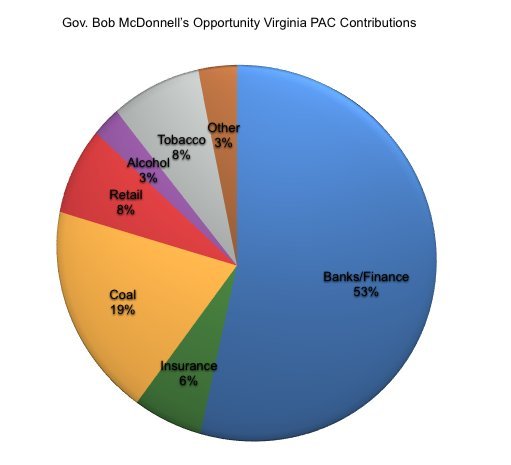
But, as Lee Fang points out over at ThinkProgress, one lost point is the extent to which all that new-look stagecraft was underwritten by Wall Street. He points out that the rebuttal pageantry, as well as the accompanying online media materials, were funded by McDonnell's Opportunity Virginia PAC. Financial disclosures subsequently reveal significant financial industry support:

Fang goes on to note, "When McDonnell opposes Obama's proposed efforts break up big banks, regulate the financial sector, and impose a financial responsibility fee to financial institutions which helped cause the current recession, it should be noted that the very industry McDonnell is fighting to defend underwrote the platform on which he is speaking, both virtually and in Richmond." But it should be noted that McDonnell made only passing mention to those White House efforts. Outside of generic free-market platitudes, McDonnell restricted his comments on the financial industry to a glancing and oblique mentions:

Many Americans are concerned about this Administration's efforts to exert greater control over car companies, banks, energy and health care.


Over-regulating employers won't create more employment; overtaxing investors won't foster more investment.

Top-down one-size fits all decision making should not replace the personal choices of free people in a free market, nor undermine the proper role of state and local governments in our system of federalism. As our Founders clearly stated, and we Governors understand, government closest to the people governs best.

The next-largest contributor, the coal industry, got a stronger shout-out from McDonnell, who urged, "We are blessed here in America with vast natural resources, and we must use them all."

But this is an interesting aspect to the potential shift in the rebuttal presentation -- fancy staging and top-flight production value cost more money. It's going to be really fun to track who pays for these things -- for each political party -- going forward.

Obama Hammers Supreme Court in Speech - CBS News

Obama Hammers Supreme Court in Speech - CBS News
...
President Obama is taking aim at the Supreme Court's recent decision to roll back limits on corporate spending on political campaigns in his State of the Union address this evening, saying the high court "reversed a century of law to open the floodgates for special interests - including foreign companies - to spend without limit in our elections."

"Well I don’t think American elections should be bankrolled by America’s most powerful interests, and worse, by foreign entities," the president will say, according to excerpts provided by the White House. "They should be decided by the American people, and that’s why I’m urging Democrats and Republicans to pass a bill that helps to right this wrong."

According to CBS News Chief Legal Correspondent Jan Crawford, "the rebuke of the Court is extraordinary." Many of the justices involved in the 5-4 decision are expected to be in the House chamber to hear Mr. Obama's speech. ...

Wednesday, January 27, 2010

OpEdNews - Article: The Supreme Court's Partisanship

OpEdNews - Article: The Supreme Court's Partisanship

The U.S. Supreme Court's landmark ruling that lets corporations spend all they want to punish political enemies and reward political friends is a reminder that the panel's Republican majority has become one more potent weapon in the Right's already intimidating arsenal.

Over the past several decades, the American Right has assembled such an array of political weaponry ranging from a vast propaganda apparatus that defines "reality" for tens of millions of Americans to specialized attack groups that can target troublesome figures in the press or academia that it's hard to envision how this powerful grip on U.S. democracy can now be broken.

The Right's influence is so wide and so deep that it can front for wealthy special interests under the guise of "populism" and persuade many Americans that their real enemy is not Big Corporations, but Big Government.

Guided by Fox News and other well-financed parts of the right-wing media, the Tea Partiers apparently believe they are engaged in a movement to free the Republic from the tyranny of the federal government, when they're actually helping consolidate the power of corporations against the only force that can possibly check corporate domination, a democratized federal government.

Adding to this political imbalance, the Supreme Court voted 5-4 on Jan. 21 to cede more power to corporate money by striking down restrictions on what corporations and other special interests can do to finance attacks on or support for a particular political candidate.

The five Republican-appointed justices left little doubt that they will be very active when partisan questions come before the court, despite their prior assurances that they detest "activist judges" and despite their promises to show great respect for legal precedents. The campaign-finance decision shattered decades of precedents and tilts the political playing field even more in the Republican direction.

This transformation of the federal courts into a powerful line of defense for Republican and corporate interests began several decades ago when the Right denounced "liberal judges" who ended racial segregation and restricted state anti-abortion laws. ...

...

Trusting the Law

Still, Gore and his lawyers voiced confidence that the rule of law would prevail, that the U.S. Supreme Court would rise above any partisan concerns and insist that the votes be counted and that the will of the voters be respected.

The Gore team went before Rehnquist's court on Dec. 11 apparently still not cognizant of the reality that whatever they argued, the five conservative justices were determined to make Bush the next President.

At about 10 p.m. on Dec. 12, 2000, five Republican justices Rehnquist, Scalia, Clarence Thomas, Sandra Day O'Connor and Anthony Kennedy ruled that the Florida recount was flawed and gave the state only two hours to correct the shortcomings and complete the tally.

Since that was impossible, the ruling essentially handed the White House to Bush.

Later, information emerged revealing that the five Republican justices had flipped their legal rationale nearly 180 degrees between Dec. 11, when they were first prepared to rule in Bush's favor, and the night of Dec. 12 when the decision to make Bush the next President finally was announced.

...

Yet possibly even more startling than the stretched logic of O'Connor and Kennedy was the readiness of Rehnquist, Scalia and Thomas to sign on to a ruling that was almost completely at odds with their original legal rationale for blocking the recount.

On the night of Dec. 11, that trio was ready to bar the recount because the Florida Supreme Court had created "new law." On Dec. 12, the same trio prevented the recount because the Florida Supreme Court had not created "new law," the establishment of precise statewide recount standards.

The five conservatives had devised their own Catch-22. If the Florida Supreme Court set clearer standards, that would be struck down as creating "new law." If the state court didn't set clearer standards, that would be struck down as violating the "equal protection" principle. Heads Bush wins; tails Gore loses.

...

Anthony DiMaggio: Supremely Swindled

Anthony DiMaggio: Supremely Swindled

The Supreme Court took a big step this week in extending corporate power in the electoral arena. In a 5-4 decision, the court struck down limits on interest groups wishing to directly fund campaign ads in the run-up to national elections. Previous rules – including the 2002 bi-partisan campaign reform act – prohibited corporations from directly funding campaign ads in Congressional races, either in favor of, or against individual candidates. Those rules have been struck down in this new decision. Previously, rules regulating spending merely required that corporate interests channel their money through formal mediums; corporations were required to filter spending through political action committees (PACs), and were still able to spend unlimited amounts on “issue ads,” although not on ads attacking specific candidates. In this sense, the Supreme Court’s ruling should not be seen as a milestone so much as one of many recent rulings seeking to strengthen corporate power. Buckley v. Valeo (1976) represents one of the earlier efforts to expand the voice of corporations, as the Supreme Court ruled that spending money on campaign contributions was a constitutionally protected form of free speech. The Supreme Court also struck down a portion of the 2002 bi-partisan campaign reform act in 2007, which prohibited corporations and unions from financing political ads during the two months before general elections and the month before primaries.
...

There are good reasons to reject the notion that campaign money is a form of free speech that nurtures democracy. One particular danger from the Supreme Court’s actions is the increased probability that businesses will stifle progressive change. Officials who enthusiastically support corporate power may be rewarded by massive increases in spending on issue and candidate ads that benefit them during re-election, while candidates who support progressive reform will be the subject of an organized business onslaught that is without financial restrictions.

The complexities of campaign finance already strongly favored business interests prior to this ruling. It’s difficult to see how reducing restrictions on lobbying will not further tip the scales in favor of business. Consider some of the following evidence regarding the entrenchment of corporate electoral power:

- Business elites already exercise the power of the purse over campaign contributions, in addition to dominating the interest group process more generally. The vast majority of campaign contributions in the 2008 election – 71 percent – came from business PACs and individuals associated with business, contrasted with just 2.7 percent of contributions from labor PACs and those associated with labor. This pattern is longstanding: 75 percent of all contributions also came from business in the 2000 election, with just 5.5 percent from labor. Privileged actors including business, trade and professional associations - which combine to form the heart of the capitalist economy - account for approximately 74 percent of the competing sides of public policy conflicts in Washington, as compared to citizens groups, unions, and all other interest groups, which make up just 10 percent of all actors.

- Business is in the best position to benefit from escalating campaign costs. Incumbents are increasingly forced to raise small fortunes to win or remain in office. While the average winner of a Senate election spent $5.2 million in 1998, that had increased to $8.5 million by 2008 (a 63 percent increase). Similarly, the average House winner spent $650,000 in 1998, and $1.37 million in 2008 (a 110 percent increase). Scholarly studies of Congress find a strong positive relationship between campaign contributions from interest groups and legislators’ voting on bills benefitting those groups. While this relationship is not consistent for public policy issues that are of high salience and strongly contested, the relationship holds for low visibility issues – which account for the vast majority of bills passed.

- Campaign Contributions and spending are most common among those of extreme wealth, not the common person. Consider that the 2008 election was the most expensive in U.S. history, with $5.3 billion raised by all candidates (compared to $4 billion in 2004). In a time when money increasingly dominates elections, those who provide contributions will exercise a major advantage in aiding their preferred candidates. In the 2002 election cycle, the richest .1 percent of Americans dominated this process, providing 80 percent of all campaign contributions. Business power is dispersed across both parties; in the 2008 election, business gave 54 percent of their donations to Democrats, and 46 percent to Republicans. The most dominant of all contributors to both parties – those who are in the best position to gain from the recent ruling – include the finance, insurance, real estate, and health care industries.

- Business interests give disproportionately more to incumbents, helping the current office holders in both parties to solidify their monopoly power and limit democratic competition. In the 1990s, it was common for incumbents in contested elections to receive 83 to 93 percent of the total contributions for their races. Business dominated elections in the U.S. are extremely uncompetitive because of the dominance of incumbents. On average, 86 percent of Senate incumbents were re-elected in the six Congressional elections from 1998 to 2008, while an average of 96 percent of House incumbents were re-elected. “Congressional stagnation” has become a serious problem, considering that the primary requisite for democratic elections is competitiveness. As of 2002, only 39 of the 435 races in the House were won with less than 55 percent of the vote. Essentially, this means that just 9 percent of House races were competitive, meaning they had an electoral margin of victory of less than ten percent. This problem continues today, with just 11 percent of elections being competitive in 2008 and with the incumbency re-election rate at 94 percent for the House and 83 percent for the Senate.

What are we to take from all these statistics? To summarize: elections are already extremely expensive and becoming more so. Business and other privileged actors dominate the electoral process, as they are the main actors in Washington and the primary financial supporters for elections. Finally, elections are largely uncompetitive with corporate financed incumbents monopolizing campaign contributions in order to appeal to the largest number of voters.

Most scholars refuse to take issue with corporate dominated elections. The dominant view in political science is that American elections are generally democratic affairs that allow voters to connect with officials in pursuit of the common good. If elections are uncompetitive, these academics often argue, it’s because the public is already so happy with its leaders and the benefits they provide in the form of constituency service and representation. There’s little reason to take these assumptions seriously in light of the widespread distrust of all levels of government among the public. According to the American National Election Study of 2004, 56 percent of Americans said “the government is pretty much run by a few big interests looking out for themselves” rather than “for the benefit of all the people.” By late 2008 the Program on International Policy Attitudes reported that 80 percent of Americans felt government was run by “a few big interests.” The same study found that 80 percent of Americans felt that “the public should have greater influence on government” than they currently do. ...

...

In the arena of political advertising, the Supreme Court’s empowerment of corporate interest groups poses an additional problem. Relaxation of the rules governing campaign ads allows business groups to increase their efforts to manipulate voters’ opinions. Voters often react strongly to political advertising.

...

Gallup reports that 55 percent of Americans think that the “same rules [should] apply to corporations, unions, and individuals” for campaign advertising. Their opinions might radically change if they were aware of the electoral trends discussed here. When I teach American Government, my students typically enter the course with little knowledge of politics and elections. Students become far more critical, however, after a review of the facets of the election business discussed above. Most Americans know little about the problems confronting our electoral system. Sadly, their ignorance is likely to continue in light of a Supreme Court ruling that emboldens privileged actors who operate behind the electoral scenes.

Anthony DiMaggio teaches American and Global Politics at Illinois State University. He is the author of Mass Media, Mass Propaganda (2008) and the forthcoming When Media Goes to War (2010). He can be reached atadimagg@ilstu.edu

Double Standard For Bernanke: Only 50 Votes Needed In Senate

Double Standard For Bernanke: Only 50 Votes Needed In Senate

When it comes to progressive priorities in the Senate, there's one standard: 60 votes are needed. But for Ben Bernanke, there's a second standard: 50 will be just fine, thank you.

Democratic leaders in the Senate are asking colleagues who are reluctant to support Bernanke's nomination for a second term as Federal Reserve chairman to nevertheless vote with them to end a filibuster and allow a vote on the actual nomination. The reluctant members would then be free to vote no to express their displeasure. Several Democrats have committed to just that and others are considering it.

The public health insurance option was stripped from health care reform because it didn't have 60 votes. An expansion of Medicare took its place but it, too, was dropped for having fewer than 60. Both proposals had at least 50 votes. Dawn Johnsen, a nominee to head the Office of Legal Counsel, has the backing of progressive organizations, but a 60-vote threshold has held her up for a year. ...

PostPartisan - Not your father's filibuster (or your mother's)

PostPartisan - Not your father's filibuster (or your mother's)

I’m glad to see that my recent columns on the dysfunctional Senate and the wall of Republican obstruction there are stirring up comment, both from a reader whose letter The Post published on Monday and from Colby King, a colleague I admire and usually agree with. We need to put the dysfunction of the Senate front-and-center in our political discussion, and the more debate, the better.
...

And, in fact, most of Bush’s nominations were not blocked by the filibuster. At the point the earlier column was written, as I noted, the Senate had approved 22 of Bush’s Circuit Court nominees and 101 nominations to district courts. I was hardly calling for the promiscuous use of filibusters, and it was not being used promiscuously.

That was then. Now, Republicans in the Senate have decided to use the filibuster on just about everything, even the recent defense appropriations bill, which, when all the delay was over, passed with overwhelming Republican support. In his excellent column on the filibuster earlier this week, the New York Times’ Paul Krugman cited important research by Congressional scholar Barbara Sinclair of UCLA on the fact that we are confronting something very new:

In the 1960s, she finds, “extended-debate-related problems” — threatened or actual filibusters — affected only 8 percent of major legislation. By the 1980s, that had risen to 27 percent. But after Democrats retook control of Congress in 2006 and Republicans found themselves in the minority, it soared to 70 percent.

Look at those numbers again: The filibuster used to be unusual – 8 percent in the 1960s. Now it’s routine – 70 percent in recent years. The filibuster has become a standard part of the way the Senate does business. That is wrong, and it creates dysfunction.

Here what Sinclair herself writes in “The New World of U. S. Senators,” her essay in Congress Reconsidered:

The last few years, and especially 2007-2008, have seen the Senate closer than ever to true gridlock. The minority party seems to perceive less danger to its reputation in almost constant obstructionism, perhaps because attentive citizens are so split along coinciding ideological and partisan lines….This is not a situation conducing to major policy accomplishments . . . .a legislative body that cannot respond to the problems that concern the people eventually loses legitimacy.

And that is what’s happening now.

10 Ways to Stop Corporate Dominance of Politics | CommonDreams.org

10 Ways to Stop Corporate Dominance of Politics | CommonDreams.org
...

But what can be done to limit or reverse the effect of the Court's decision? Here are 10 ideas:

  1. Amend the U.S. Constitution to declare that corporations are not persons and do not have the rights of human beings. Since the First Amendment case for corporate spending as a free speech right rests on corporations being considered "persons," the proposed amendment would strike at the core of the ruling's justification. The push for the 28th Amendment is coming from the grassroots, where a prairie fire is catching on from groups such as Public Citizen, Voter Action, and the Campaign to Legalize Democracy.
  2. Require shareholders to approve political spending by their corporations.Public Citizen and the Brennan Center for Justice are among the groups advocating this measure, and some members of Congress appear interested. Britain has required such shareholder approval since 2000.
  3. Pass the Fair Elections Now Act, which provides federal financing for Congressional elections. This measure has the backing of organizations representing millions of Americans, including Moveon.org, the NAACP, the Service Employees International Union, and the League of Young Voters. Interestingly, the heads of a number of major corporations have also signed on, including those of Ben & Jerry's, Hasbro, Crate & Barrel, and the former head of Delta Airlines.
  4. Give qualified candidates equal amounts of free broadcast air time for political messages. This would limit the advantages of paid advertisements in reaching the public through television where most political spending goes.
  5. Ban political advertising by corporations that receive government money, hire lobbyists, or collect most of their revenue abroad. A fear that many observers have noted is that the Court's ruling will allow foreign corporations to influence U.S. elections. According to The New York Times, Sen. Charles Schumer (D-New York) and Rep. Chris Van Hollen (D-Maryland) are exploring this option.
  6. Impose a 500 percent excise tax on corporate contributions to political committees and on corporate expenditures on political advocacy campaigns. Representative Alan Grayson (D-Florida) proposes this, calling it "The Business Should Mind Its Own Business Act."
  7. Prohibit companies from trading their stock on national exchanges if they make political contributions and expenditures. Another one from Grayson, which he calls "The Public Company Responsibility Act."
  8. Require publicly traded companies to disclose in SEC filings money used for the purpose of influencing public opinion, rather than for promoting their products. Grayson calls this "The Corporate Propaganda Sunshine Act."
  9. Require the corporate CEO to appear as sponsor of commercials that his or her company pays for, another possibility from the Schumer-Van Hollen team, according to The New York Times
  10. Publicize the reform options, inform the public of who is making contributions to whom, and activate the citizenry. If we are to safeguard our democracy, media must inform and citizens must act.

The measures listed above-and others that seek to reverse the dominance of money in our political system-will not be easy. But grassroots anger at this latest win for corporate power is running high. History shows that when the public is sufficiently aroused, actions that once seemed impossible can, in hindsight, seem inevitable.

Who's activist now? In election spending case, conservatives | McClatchy

Who's activist now? In election spending case, conservatives | McClatchy

WASHINGTON — The Supreme Court's decision Thursday to lift long-standing limits on corporate campaign spending exalts free speech above fears about political corruption.

The 5-4 ruling exposes how the court's stark ideological divide is stronger than Chief Justice John G. Roberts' stated fealty to precedence and consensus building. It's a markedly activist decision, going well beyond what the justices were asked to do.

And, not least, the decision in Citizens United v. Federal Election Commission will almost certainly incite further efforts to unravel campaign finance restrictions in the name of the First Amendment.

"Political speech must prevail against laws that would suppress it, whether by design or inadvertence," Justice Anthony Kennedy wrote for the court's majority.

...

Legally, the decision could have equally dramatic effects. These include shaping the long-term jurisprudential reputations of Roberts and his colleagues.

During his 2005 Senate confirmation hearing, Roberts assured lawmakers that he would strive to achieve more unified court decisions. He further insisted that "judges have to have the humility to recognize that they operate within a system of precedent" that binds the court.

However, in what New York University Law School Professor Burt Neuborne called a "terrible, terrible body blow" to the court's institutional standing, Thursday's decision explicitly reversed an entire 1990 decision and part of a 2003 decision. Stevens spent a good portion of his 90-page dissent denouncing the seeming disregard for stare decisis, the principle of heeding past decisions.

"The majority blazes through our precedents, overruling or disavowing a body of case law," Stevens wrote, adding that "the path it has taken to reach its outcome will, I fear, do damage to this institution."

Ironically, the 57-page opinion that united the court's conservative wing might also provide ammunition for critics of "activist" judges.

...

Report: Bush order allowing murder of US citizens abroad still in effect | Raw Story

Report: Bush order allowing murder of US citizens abroad still in effect | Raw Story

If a United States citizen was determined to have joined a foreign terrorist group, that person could be legally murdered under orders given by President George W. Bush after the 9/11 attacks.

In spite of an administration change in Washington, D.C., that allowance is still in effect, according to a late-breaking report inThe Washington Post on Tuesday.

The report delves into an increasing American role in Yemen, spotlighting an effort to capture or kill Anwar al Awlaki, an American citizen who exchanged e-mails with alleged Fort Hood shooter Nidal Hasan.

"After the Sept. 11, 2001, attacks, Bush gave the CIA, and later the military, authority to kill U.S. citizens abroad if strong evidence existed that an American was involved in organizing or carrying out terrorist actions against the United States or U.S. interests, military and intelligence officials said," the Post reported. "The evidence has to meet a certain, defined threshold. The person, for instance, has to pose 'a continuing and imminent threat to U.S. persons and interests,' said one former intelligence official. ...

Tuesday, January 26, 2010

Democracy in America Is a Useful Fiction | CommonDreams.org

Democracy in America Is a Useful Fiction | CommonDreams.org

by Chris Hedges

Corporate forces, long before the Supreme Court's decision in Citizens United v. Federal Election Commission, carried out a coup d'état in slow motion. The coup is over. We lost. The ruling is one more judicial effort to streamline mechanisms for corporate control. It exposes the myth of a functioning democracy and the triumph of corporate power. But it does not significantly alter the political landscape. The corporate state is firmly cemented in place.

The fiction of democracy remains useful, not only for corporations, but for our bankrupt liberal class. If the fiction is seriously challenged, liberals will be forced to consider actual resistance, which will be neither pleasant nor easy. As long as a democratic facade exists, liberals can engage in an empty moral posturing that requires little sacrifice or commitment. They can be the self-appointed scolds of the Democratic Party, acting as if they are part of the debate and feel vindicated by their cries of protest.

Much of the outrage expressed about the court's ruling is the outrage of those who prefer this choreographed charade. As long as the charade is played, they do not have to consider how to combat what the political philosopher Sheldon Wolin calls our system of "inverted totalitarianism."

Inverted totalitarianism represents "the political coming of age of corporate power and the political demobilization of the citizenry," Wolin writes in "Democracy Incorporated." Inverted totalitarianism differs from classical forms of totalitarianism, which revolve around a demagogue or charismatic leader, and finds its expression in the anonymity of the corporate state. The corporate forces behind inverted totalitarianism do not, as classical totalitarian movements do, boast of replacing decaying structures with a new, revolutionary structure. They purport to honor electoral politics, freedom and the Constitution. But they so corrupt and manipulate the levers of power as to make democracy impossible.

Inverted totalitarianism is not conceptualized as an ideology or objectified in public policy. It is furthered by "power-holders and citizens who often seem unaware of the deeper consequences of their actions or inactions," Wolin writes. But it is as dangerous as classical forms of totalitarianism. In a system of inverted totalitarianism, as this court ruling illustrates, it is not necessary to rewrite the Constitution, as fascist and communist regimes do. It is enough to exploit legitimate power by means of judicial and legislative interpretation. This exploitation ensures that huge corporate campaign contributions are protected speech under the First Amendment. It ensures that heavily financed and organized lobbying by large corporations is interpreted as an application of the people's right to petition the government. The court again ratified the concept that corporations are persons, except in those cases where the "persons" agree to a "settlement." Those within corporations who commit crimes can avoid going to prison by paying large sums of money to the government while, according to this twisted judicial reasoning, not "admitting any wrongdoing." There is a word for this. It is called corruption.

Corporations have 35,000 lobbyists in Washington and thousands more in state capitals that dole out corporate money to shape and write legislation. ...

Stern Lashes Out At Senate Dems, Calls Some Legislative 'Terrorists'

Stern Lashes Out At Senate Dems, Calls Some Legislative 'Terrorists'

Two of the most powerful union officials in the country lashed out at Senate Democrats on Tuesday, jokingly calling some of them legislative "terrorists" and slamming leadership for "squandering" a supermajority in the Senate.

Pointing to the failure of Congress to pass health care reform and effectively stimulate job creation, SEIU president Andy Stern insisted that "unless something dramatic happens here" the country's labor activists will not be eager to help the Democratic Party in the 2010 elections. Speaking at a forum on the state of the American worker at the Center for American Progress, he urged House Democrats to pass the Senate's version of health care legislation with promises that it will be amended after the fact using reconciliation. And he called on President Obama to drive home this point during the State of the Union address on Wednesday.

"Take the Senate bill as it is as the foundation to find ways whether through reconciliation or other legislative processes to try and fix the things that a lot of people think need to be fixed both now in the House and the Senate," Stern said. "I think going through reconciliation we don't have Ben Nelson or Joe Lieberman to kick around anymore. So the 58 other senators get to decide something they maybe didn't get to decide the first time around because of the hostage-taking that is going on in the Senate."

Stern wasn't done lashing out at Lieberman, Nelson and the other conservative members of the Senate Democratic caucus. Reflecting on the policy changes that these senators secured during health care negotiations, he argued that the country "should send the national security people over to [the Senate to] explain to them why we don't negotiate with terrorists..."

"Because there are a lot of terrorists in the Senate who think we are supposed to negotiate with them when they have their particular needs that they want met," he added. ...